
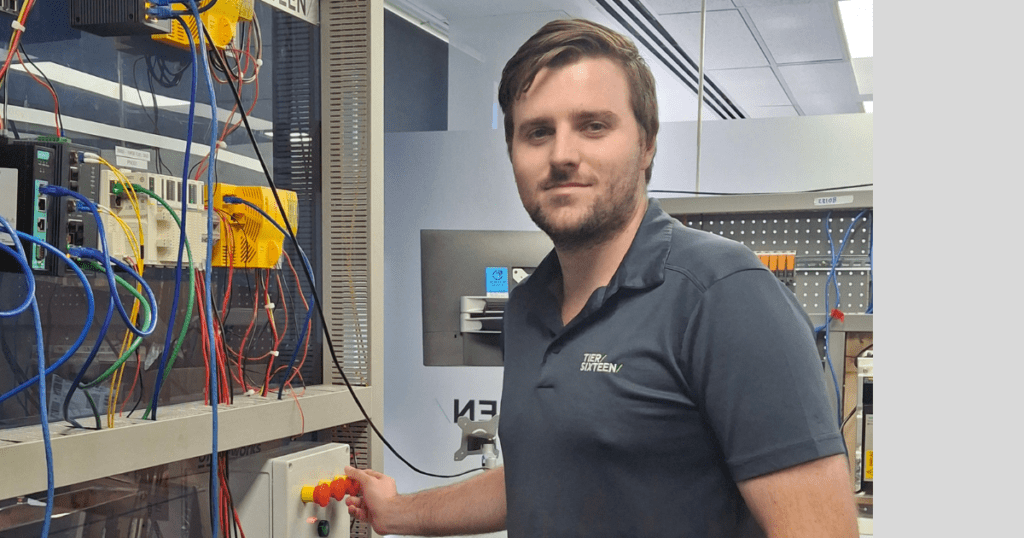
You joined us through the graduate growth program five years ago. What initially attracted you to Tier Sixteen, and how did the program shape your early career?
I was initially drawn to Tier Sixteen because of its integrator status. I appreciated that it was a small company rather than a large corporate organisation, as I felt this would provide more opportunities to contribute meaningfully and explore which area of the industry, I might want to dedicate my career to.
The Graduate Growth Program allowed me to learn on the job and contribute to real projects from the very start of my career. It also offered structured training that complemented my work while building expertise in platforms essential for future projects. Examples include PLC platforms such as Schneider Modicon PLCs, Rockwell ControlLogix, and Siemens S7, as well as SCADA platforms like Citect SCADA, Ignition, Plant SCADA, FactoryTalk, and Cimplicity.
This foundation allowed me to take on progressively more responsibility, guided by experienced engineers and Steve, which greatly accelerated my development.
Real-world project exposure: can you share a project experience that really accelerated your growth as a control systems engineer?
One project that truly opened my eyes was the Koodaideri Iron Ore Commissioning, where Tier Sixteen provided control systems commissioning support. I spent several months FIFO, commissioning NPI assets, and assisting other engineers with plant asset commissioning. This experience gave me a rapid and comprehensive understanding of the full process of a dry ore mine and introduced me to the challenges of FIFO work.
Another project that stands out was the Port Hedland Solar Farm. This was my introduction to renewable technology and solar farms. I had the opportunity to design their GeoSCADA system, which was very different from other SCADA platforms I had used. It required a scalable design since solar farms are composed of many repeating units, providing a unique and valuable learning experience.
What makes control systems engineering particularly interesting to you, and what sets this environment apart from others in the industry?
What I find most rewarding is taking an asset from design to implementation and then commissioning it. Commissioning brings immense satisfaction, it is the moment when all the hard work during development comes to life. Being responsible for bringing an asset to life is what sets control systems engineering apart.
I also enjoy that the field blends multiple disciplines. To excel, you need electrical, mechanical, and IT knowledge, which keeps the work engaging and diverse.
How did mentoring, technical training, and exposure to certified automation partners influence your development over the past five years?
Access to a mentor during my formative years was highly influential. Mentors acted not only as teachers but also as sounding boards, providing constructive feedback that helped shape the thought processes I now rely on in my work.
I was fortunate to receive extensive training from our team, vendors, and automation partners through hands-on demonstrations, lunch-and-learns, online courses, and certifications. One notable example was receiving support and time to complete the Inductive Automation Ignition Core and Gold certifications. These experiences allowed me to develop expertise in a wide range of control system platforms used across Western Australia and globally. If I could share two guiding principles I embrace, they would be: be curious and be proactive. As I’ve progressed from mentee to mentor, I’ve realised that the trait I most admire in young engineers is curiosity paired with the ability to attempt problem-solving independently.
For graduates considering a career in automation (control systems) and operational technology, what would you tell them about starting their journey at Tier Sixteen?
Starting your journey at Tier Sixteen is both rewarding and enriching. The company provides a structured yet flexible environment, combining formal training with on-the-job learning through meaningful projects. Engineers are given opportunities to build trust, work autonomously, and receive mentorship when needed.
Since Tier Sixteen operates across multiple industries, graduates gain exposure to a wide variety of systems, helping them discover which sector they are most passionate about.
Overall, it is an ideal environment for building a solid foundation and launching a successful career in control systems engineering.
Interview with Timothy Adams