
OPERATIONAL TECHNOLOGY (OT) Maturity: What’s Next
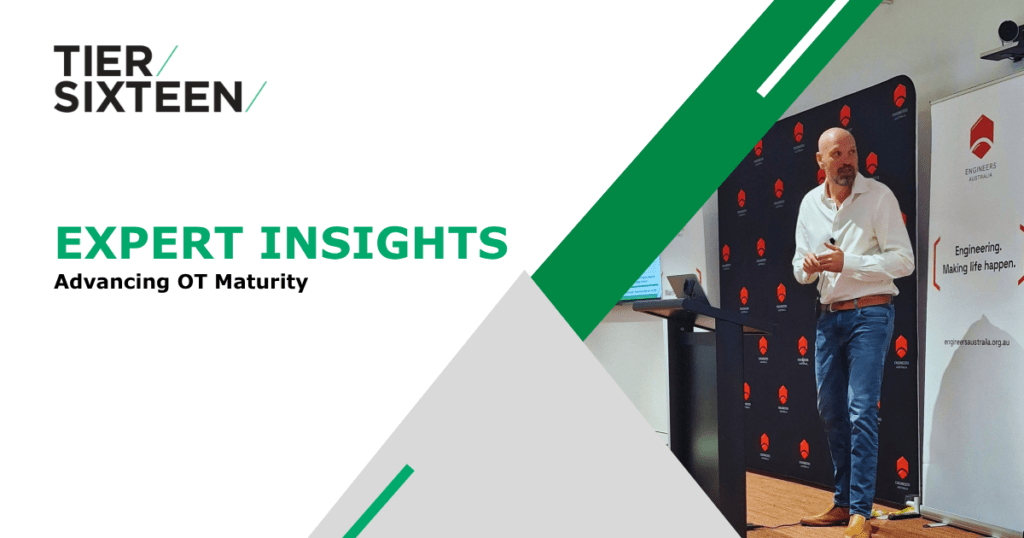
By invitation from the Electric Energy Society of Australia (EESA), this discussion delivered in collaboration with Tier16 brought together key perspectives on the evolving role of operational technology (OT) in modern industrial environments.
A key challenge confronting modern organisations is the maturity of the OT stack.
From Static Inventory to Foundational Maturity
Most OT environments today still sit at a foundational stage of maturity. Asset visibility is typically maintained through basic registers, while patching and vulnerability management are often manual, scheduled around production constraints, and heavily dependent on vendor cycles. Although these systems remain operationally stable, they suffer from persistent gaps:
- Limited real-time visibility across OT networks
- Incomplete or outdated asset inventories
- Minimal automation in vulnerability detection and tracking
- Recovery plans that are documented but rarely tested in practice
- Compliance evidence that is assembled after the fact rather than continuously generated
The result is a model where assurance exists, but is largely retrospective rather than continuous.
The External Forces Driving Change
The shift up the OT maturity curve is being accelerated by three converging forces. Regulation has fundamentally changed expectations. Frameworks such as SOCI obligations have moved organisations from simply implementing controls to actively proving that those controls are operating effectively on an ongoing basis.
Insurance providers are reinforcing this shift by tightening underwriting conditions. Coverage is increasingly tied to demonstrable cyber resilience, not assumed reliability. In practice, this means organisations must show evidence of preparedness, not just intent.
At the same time, supply chain pressure is growing. Large industrial operators and critical infrastructure partners now require greater transparency into OT security posture, particularly where operational disruption could have cascading effects. Together, these drivers are making basic asset inventories and periodic audits insufficient. Continuous visibility and verifiable assurance are becoming mandatory expectations.
The Emerging OT Stack: Continuous Assurance and Resilience
The next generation of OT environments is defined by automation, integration, and resilience-by-design. Rather than treating cybersecurity and compliance as external layers, they are becoming embedded into core operational processes.
Key capabilities shaping this future include:
- Continuous vulnerability management that respects operational safety windows and vendor constraints
- Immutable, regularly tested backups that ensure recovery is provable, not theoretical
- Automated compliance reporting that produces audit-ready evidence in real time
- Risk and dependency mapping that connects OT assets to production outcomes and external infrastructure
- OT-specific threat intelligence tailored to industrial protocols and attack patterns
- Integrated incident response models that unify IT and OT recovery workflows
Resilience is not a periodic exercise, it is a continuously maintained state. Unlike traditional IT systems, failures in OT environments have immediate physical and operational consequences. OT maturity is moving from reactive management toward continuous assurance,
How to Build Operational Resilience in Operational Technology Environments?
- Promote the strategic importance of OT software in your organisation, supported by best practices in OT software asset management and compliance visibility.
- Assess organisational maturity and establish a clear understanding of the current software asset landscape.
- Ensure OT software assets are accurately identified, classified and managed.
- Develop and maintain robust business processes that effectively support the management of OT software.
- Identify, document and manage dependencies between systems to reduce operational and cybersecurity risk.
- Establish proactive planning to address software obsolescence and limitations.
- Build people’s capability within the organisation to support the software stack.
- Recognise the increasing maturity of the OT software environment and develop a strategic roadmap for continuous improvement and future-state capability.
Organisations that adapt early will not only meet SOCI compliance requirements more effectively – they will also build more transparent and resilient industrial operations over time.